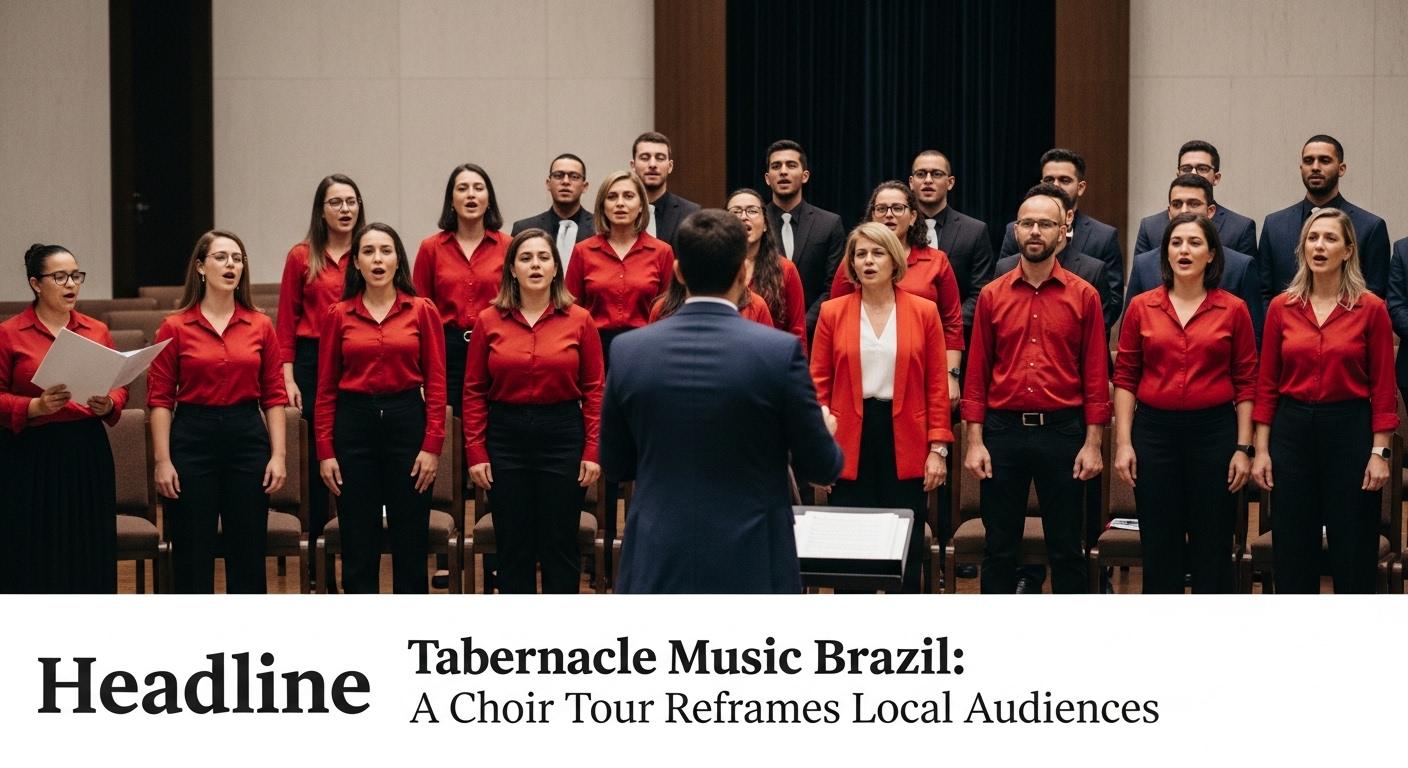
Concert scene featuring a choir and orchestra on a Brazilian stage during a touring program.
Updated: April 13, 2026
In tabernacle Music Brazil, a deep look at São Paulo’s concert scene reveals how international choirs, local ensembles, and audience rituals are co-evolving, turning a once niche phenomenon into a recurrent cultural moment.
Context: Brazil’s Music Scene and the São Paulo Circuit
São Paulo stands as Brazil’s most dynamic musical engine, where classical training, gospel-inflected singing, and modern pop mingle in venues from historic theatres to large arenas. The recent touring activity by international choral groups—most notably a prominent choir and orchestra that staged its first Songs of Hope concert in Brazil—illustrates a broader appetite for cross-cultural programs that can scale with audience expectations. Local promoters note that Brazilian listeners increasingly value live experiences that blend reverence with technical polish, and that many fans discover new sounds through streaming platforms that translate stage success into global curiosity.
The São Paulo circuit supports a dense calendar of festivals, church concerts, and university showcases, enabling artists to experiment with mixing timbres: a Brazilian percussion groove meeting a European choral line, or a gospel repertoire threaded with Brazilian regional flavors. The result is not simply a transfer of content but a transfer of methods—how rehearsals are structured, how audiences engage between numbers, and how producers think about acoustics and attendance thresholds.
The Global-Local Convergence: Tabernacle Choir and Brazilian Audiences
The Tabernacle Choir’s São Paulo stop, backed by an orchestra, captures a moment when a highly polished, globally recognized choral entity begins to regard Brazil not as a one-off audience but as a consistent site for exchange. On stage, the ensemble presents a repertoire steeped in history while negotiating Brazilian acoustics—timbres, speech patterns, and the physical energy of a live crowd. Audience reaction—standing ovations, engaged silence, and social media chatter—signals a willingness to receive high-art choral textures alongside more familiar local genres.
For Brazilian listeners, the encounter offers a social signal: that world-class choral music belongs here, not merely as a novelty but as part of a continuum that includes gospel, MPB, and contemporary Brazilian pop. For promoters, it sharpens questions about residency programs, collaboration cycles, and the curation of programs that honor both the integrity of the source material and the specificity of Brazilian musical memory. In practical terms, it may lead to co-commissioned works, artist-in-residence formats, and joint tours that leverage local choirs as transit partners rather than afterthoughts.
Economic and Cultural Dynamics: Venues, Streaming, and Local Impact
Touring acts justify high production values because audiences in megacities like São Paulo are accustomed to the theatre of large-scale performances, yet the economics remain delicate. Ticket pricing, sponsorship, and the cost of orchestral accompaniment all shape how often a city can host similar events. At the same time, streaming clips and curated playlists extend the life of a concert far beyond the night of the performance, creating a pipeline that can feed tours and inform future programming. For local artists, the presence of an international choir offers a blueprint for performance standards and technical excellence, potentially lifting the bar for training programs, rehearsal facilities, and sound engineering talent in the city.
There is also a cultural return on investment: exposure to a global repertoire can inspire Brazilian choirs to explore new arrangements or to fuse native rhythms with classical lines. However, organizers should balance spectacle with opportunity for domestic acts to shine, ensuring that the momentum does not eclipse local voices. In a scenario where these global-local exchanges become routine, one could imagine a Brazilian concert ecosystem that stages multi-genre collaborations on a regular basis, supported by municipal or state cultural funds, and reinforced by educational outreach in schools and churches.
Actionable Takeaways
- Develop structured collaborations between international choirs and Brazilian artists to produce new works that honor both traditions.
- Invest in artist residencies and masterclasses in São Paulo to build long-term bridges and local capacity in choral and orchestral performance.
- Launch bilingual marketing and audience-engagement campaigns to broaden reach among diverse Brazilian communities and visitors.
- Leverage streaming data to tailor programming, subtitles, and accessibility options that grow the global audience for tabernacle Music Brazil-style projects.
- Foster partnerships with churches, universities, and cultural institutions to create recurring platforms for live choral excellence and community participation.
Source Context
The following sources provide background on recent Tabernacle Choir performances in Brazil and related coverage: